
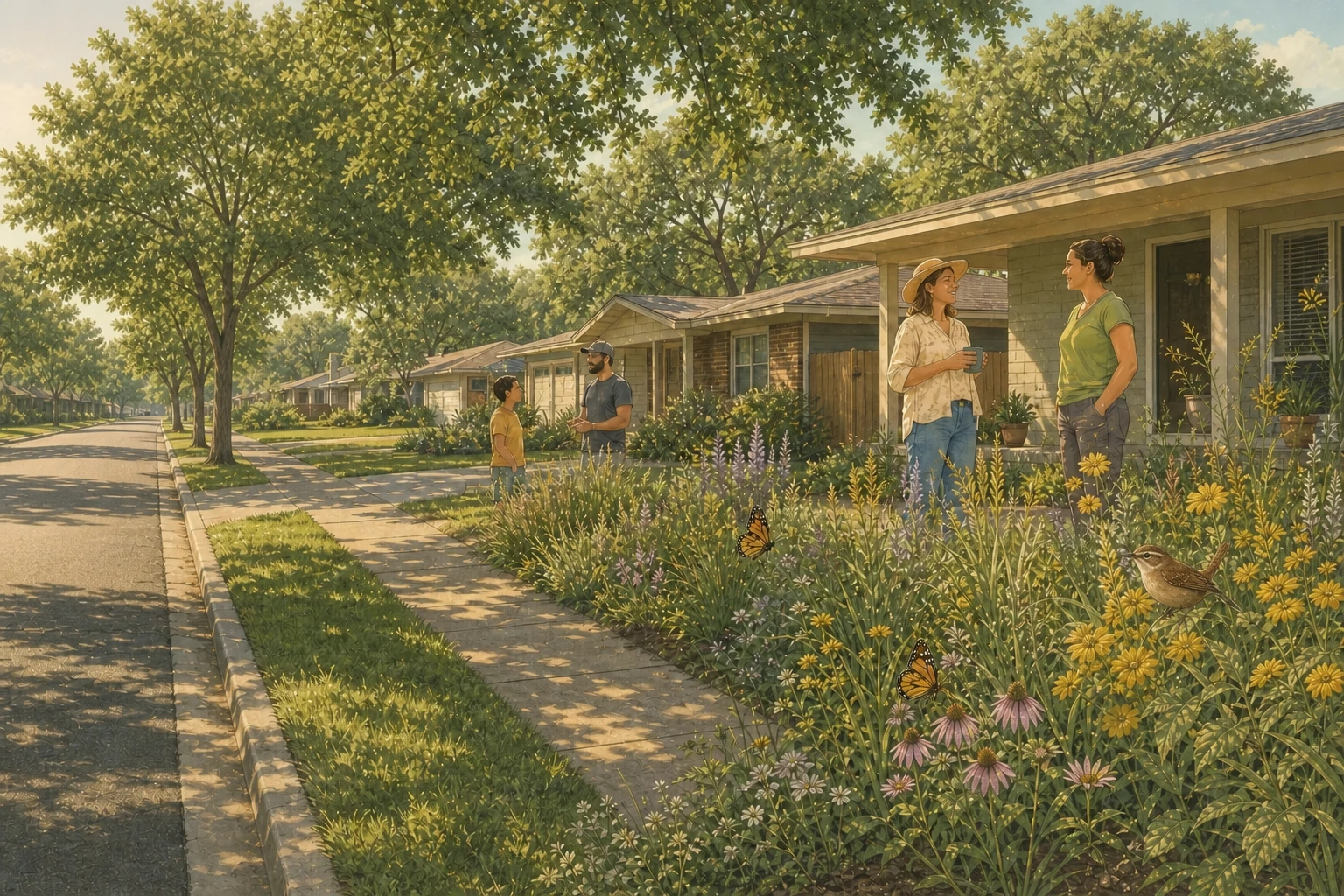
What if the path to a healthier neighborhood began in the front yard?
It does not require a total landscape makeover or a perfect plan. It can begin with one sunny patch of lawn replaced by native grasses and flowers—and one neighbor stopping to ask, “What are you growing?”
I like the word yardener because it invites us to see a yard as more than decoration: it is also habitat, outdoor room, and neighborhood commons.
A native yardener chooses plants that belong to the local ecological community. Here in the Houston region, that can mean bringing a small piece of Gulf Coast prairie life back into a residential landscape.
A pocket prairie is small and mighty
A pocket prairie is a small planting made with prairie plants native to the region. It can fit beside a driveway, along a front walk, or in a modest section of lawn.
The University of Houston Coastal Center reports that less than one percent of the coastal prairie that once covered about 6.5 million Texas Gulf Coast acres remains. A residential planting cannot recreate an intact remnant. It can still offer food, shelter, rain absorption, and a resting place for insects and birds.
Native plants help us use water thoughtfully
A conventional lawn can require irrigation, mowing, fertilizer, and other inputs to stay green—especially when poorly matched to the site.
Locally appropriate native plants are adapted to regional heat, drought, heavy rain, and soil. Once established in the right place, many need less supplemental water. Houston Audubon notes that local native wildflowers, grasses, and forbs generally require less water, maintenance, and fertilizer than many other landscape plants.
Once established is important. New native plants need attentive watering while their roots settle in. Sun, drainage, soil, mature size, and local range still matter.
Prairie plants also help us think differently about rain. Vegetation and healthy soil can slow and absorb some rainfall instead of rushing every drop off compacted lawn and pavement. One yard is not a flood-control system, yet many yards with more living, permeable ground can make a meaningful difference.
More plants can mean a cooler place to live
On a Houston summer afternoon, the difference between an exposed driveway and a shaded, planted bed can be felt immediately.
Hard surfaces absorb and store solar energy. Vegetation cools through shade and evapotranspiration, the release of water vapor through leaves. The U.S. Environmental Protection Agency identifies trees and vegetation as tools for lowering local temperatures while supporting stormwater management and wildlife habitat.
A pocket prairie will not cool an entire block or replace mature tree canopy. Layered vegetation can still shade soil and make a corner more hospitable. Heat resilience grows through plants, protected soil, less pavement, and shared effort.
For wildlife, our property lines do not exist
A butterfly does not know when it has crossed into a neighbor’s yard. A bird does not care which family planted the shrub that holds its berries. Native bees do not check a property survey before searching for pollen or a nesting place.
One native garden can become a stepping stone: a place to feed, shelter, nest, or pause. When several neighbors add native patches, those stepping stones can create a more connected route between larger green spaces. Plant diversity, bloom timing, nesting resources, pesticide use, barriers, and distance determine how useful each patch will be. A row of gardens is not automatically a fully functioning corridor, though connection remains a powerful goal.
This idea is central to Homegrown National Park, the grassroots movement co-founded by entomologist Doug Tallamy. It encourages people to reduce lawn, plant locally appropriate natives, remove invasive plants, and connect those efforts. Its Biodiversity Map makes their shared reach visible.
Native plants are especially valuable because local wildlife has longstanding relationships with them. Some butterflies and moths depend on particular host plants, and their caterpillars feed nesting birds. A Washington, D.C.-region study found that yards dominated by nonnative plants produced less suitable insect food and were associated with lower Carolina chickadee population growth. Houston’s details will differ, while the lesson remains: what we plant shapes the food web.
A useful patch can include flowers across the seasons, host plants, seed heads, cover, healthy soil, and places where insects complete their life cycles. Avoiding routine pesticide use helps protect the creatures we hope to welcome.
The front yard can care for us, too
Gardening brings us outside with a purpose. We water a plant and notice a bee sleeping in a flower. We pull a weed, hear an unfamiliar bird, and breathe a little more slowly before going inside.
A meta-analysis of 22 studies found a positive relationship between gardening and outcomes related to stress, mood, quality of life, and community. Gardening does not replace professional mental-health care, though gentle movement, sensory attention, and time outdoors can support us.
The front yard adds a social dimension. Research summarized by the Royal Horticultural Society found that people caring for front gardens described feeling closer to neighbors through informal conversation and shared knowledge.
A garden gives people something easy to discuss. “What is that purple flower?” can become a conversation about butterflies. A divided plant can become a gift. Community does not always need a formal event—only time to be visible, unhurried, and open to conversation.
From one pocket prairie to a neighborhood pathway
A wildlife corridor can begin with a simple invitation:
- Start with one manageable patch. Observe its sun, water, soil, and visitors before choosing plants.
- Choose local natives. Southeast Texas guides from the Coastal Prairie Conservancy, Houston Audubon, and Native Plant Society of Texas can help.
- Show that the garden is cared for. Use a clear border, repeat plants in groups, and keep walkways open.
- Invite rather than lecture. Share a plant, nursery list, or butterfly sighting. Ask what your neighbor wants from their yard.
- Connect and map the patches. Look for another stepping stone, such as a curbside bed, native shrub, school garden, or pesticide-free flowering strip. Participants can add plantings to the Homegrown National Park Biodiversity Map.
Every yard can contribute differently: a pocket prairie, two native shrubs, or containers used with the property owner’s permission. The corridor becomes stronger through participation, not uniformity.
Check local ordinances, utility locations, sight-line requirements, and neighborhood rules before changing a visible planting. Start small enough to maintain and keep sidewalks and traffic views clear.
A neighborhood can grow differently
Going native is about seeing home as part of a living system. Rain continues into a watershed. A caterpillar may become food for a young bird. Shade can make the sidewalk kinder. A flower that catches a neighbor’s attention can open the door to friendship.
One household cannot solve urban heat, habitat fragmentation, or water scarcity alone. One front yard can still become cooler, more absorbent, and more alive. When neighbors place native patches within reach of one another, private yards can become something shared: a pathway for wildlife, a place for people, and a neighborhood learning how to grow together.
References and further reading
- University of Houston Coastal Center. “Habitats: Coastal Prairie.” Overview of Gulf Coast prairie history, biodiversity, water functions, and the estimate that less than one percent remains.
- HERE in Houston. “Build a Pocket Prairie.” Houston-area guidance on pocket-prairie size, site assessment, plant selection, community participation, and maintenance.
- Coastal Prairie Conservancy. “9 Natives Program: Native Plants for Home and Community Gardens.” Southeast Texas planting guides and information about habitat, soil, and rainwater benefits.
- Houston Audubon. “Natives Nursery.” Information about locally sourced native prairie plants and their value to birds and pollinators.
- Native Plant Society of Texas. “Why Native Plants?” Texas-focused overview of biodiversity, water conservation, soil protection, and habitat benefits.
- Texas Parks and Wildlife Department. “Habitat Resources.” Guidance on native plants, bird habitat, water retention, and reduced-mowing areas.
- U.S. Environmental Protection Agency. “Benefits of Trees and Vegetation.” Evidence and mechanisms for local cooling, stormwater management, quality of life, and wildlife habitat.
- Silva, J. L. S., et al. (2021). “Plant–pollinator interactions in urban ecosystems worldwide: A comprehensive review including research funding and policy actions.” Ambio, 50, 884–900. https://doi.org/10.1007/s13280-020-01410-z
- Narango, D. L., Tallamy, D. W., & Marra, P. P. (2018). “Nonnative plants reduce population growth of an insectivorous bird.” Proceedings of the National Academy of Sciences, 115(45), 11549–11554. https://doi.org/10.1073/pnas.1809259115
- Soga, M., Gaston, K. J., & Yamaura, Y. (2017). “Gardening is beneficial for health: A meta-analysis.” Preventive Medicine Reports, 5, 92–99. https://doi.org/10.1016/j.pmedr.2016.11.007
- Royal Horticultural Society. “Why Gardening Makes Us Feel Better.” Research summary on gardening, well-being, and neighbor connection through front gardens.
- Native Plant Society of Texas. “Native Plant Database.” Search tool for checking Texas native plants by landscape attributes.
- Homegrown National Park. “Homegrown National Park.” Grassroots call to regenerate biodiversity by reducing lawn, planting natives, removing invasive plants, and rebuilding ecological networks where people live and work.
- Homegrown National Park. “Biodiversity Map.” Community map for recording native plantings and visualizing their collective reach.
- Homegrown National Park. “Doug Tallamy.” Background on the movement’s co-founder and links between native plants, insects, birds, and functioning food webs.